
If you type “Anti-Static Poly Tubing Roll” into Google Images, 95% of what pops up is bubblegum pink. Yet when our extrusion lines at Lucheng Packaging run ESD drum liners and heavy-duty conductive rolls for multinational paint, resin, and solvent plants, the film is almost always jet black.
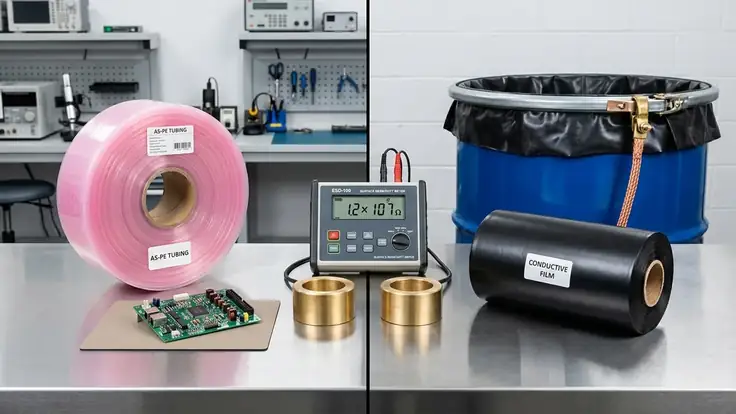
Here is why: Pink poly is static-dissipative ($10^9 sim 10^{11} Omega/ ext{sq}$). The pink tint is just a visual dye added alongside migrating surfactant additives so warehouse staff can see parts and scan barcodes through the bag without causing hard short-circuits on live PCBs. Black conductive poly ($10^3 sim 10^5 Omega/ ext{sq}$) is compounded with 12%–20% conductive carbon black. It is 100% opaque and too conductive for live battery-backed circuit boards—but it is the only permanent, humidity-independent way to ground 200L chemical drums in ATEX Zone 1 & Zone 2 solvent areas without risking a vapor flash fire.
1. Industry Convention: Does the Pink Dye Actually Stop Static?
Let’s clear up the biggest misconception we hear from junior buyers: pink pigment has zero electrical conductivity. Pure low-density polyethylene (LDPE) and linear low-density polyethylene (LLDPE) are classic electrical insulators. Left untreated, stripping a clear poly bag off a roll generates thousands of volts of triboelectric charge—more than enough to fry a CMOS gate or ignite toluene vapors.
When electronics standards like EIA-541 and the US military barrier specification MIL-PRF-81705 Type II were first established, factories had a practical floor-management headache: untreated PE film is clear, and PE film compounded with internal anti-static surfactants (like ethoxylated tertiary amines or glycerol monostearate) is also naturally clear.
🌸 The Role of Pink Masterbatch
To stop line operators from accidentally grabbing ordinary insulating poly rolls from the warehouse rack and bringing an ESD time-bomb onto an assembly bench, standards committees mandated a universal visual tint: translucent pink. The pink color is simply a 1%–2% color masterbatch telling quality auditors at 20 paces: “This roll has been dosed with an anti-static agent.”
🖤 Why Carbon Black Doesn’t Need Dye
By contrast, when we extrude permanent conductive PE film at Lucheng, we aren’t spraying on a surface coating or relying on a trace surfactant. We compound high-structure conductive carbon black directly into the polymer matrix. At a 12% to 20% percolation loading, the carbon network turns the resin pitch-black by nature.
2. Why “Poly Tubing Rolls” Are Almost Never Made in Black
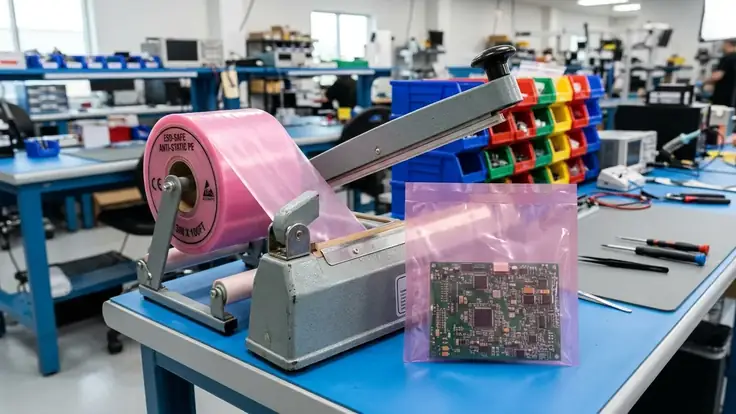
Think about how a customer actually uses a Poly Tubing Roll. Instead of buying pre-made flat bags in 15 different lengths, a kitting warehouse mounts a continuous sleeve of poly tubing onto a benchtop dispenser, slides in a wiring harness, metal bracket, or circuit board, cuts the sleeve to length, and seals both ends with a desktop impulse heat sealer.
In that specific benchtop workflow, swapping translucent pink film for carbon-loaded black conductive film creates four immediate headaches on the shop floor:
Pain Point #1: 100% Opacity Kills Visual QC & Barcode Scanning
Pink poly tubing is semi-transparent. Once a PCB, cable assembly, or CNC-machined valve is sealed inside, warehouse pickers and customs inspectors can read the internal part number with the naked eye and shoot a laser or CMOS barcode scanner right through the film. Carbon-black conductive film has zero light transmission. Seal a part inside a black tube, and it’s in a black box—if an operator forgets to stick an external thermal label on the bag, the only way to verify what’s inside is to rip the bag open.
Pain Point #2: Hard Short-Circuit & Spark Discharge on Live Boards
In electrostatic protection (IEC 61340-5-1), lower resistance is not always safer:
- Pink Anti-Static PE ($10^9 sim 10^{11} Omega/ ext{sq}$): Designed for tribocharging prevention and controlled, slow charge bleed-off. If you slide a telecom board with a live 3V CMOS coin-cell battery or charged decoupling capacitors into a pink poly bag, the high surface resistance prevents current from bridging across exposed pins.
- Black Conductive PE ($10^3 sim 10^5 Omega/ ext{sq}$): Acts like a flexible sheet of low-grade resistor. If exposed leads of a powered sub-assembly touch the inner wall of a black carbon bag, it can drain the battery or trigger an instantaneous capacitive spark discharge right across sensitive IC pins.
Pain Point #3: Carbon Sloughing in Cleanrooms
To achieve a continuous conductive percolation pathway through polyethylene, carbon black loading typically sits between 12% and 20% by weight. When standard-grade black conductive tubing is repeatedly creased, sheared by cutter blades, or vibrated during air freight, microscopic carbon particles can rub off (“carbon sloughing”). For precision optical sensors, medical implants, or Class 10,000 cleanroom assemblies, black particulate shedding is a dealbreaker—which is why Lucheng developed co-extruded and nano-dispersed formulations that lock the carbon layer away from the product contact surface.
Pain Point #4: Narrower Impulse Heat-Sealing Window
Because pink poly uses only 1%–3% migrating additive, the virgin LDPE melt flow index (MFI) and seal strength remain virtually identical to clear film; a cheap benchtop impulse sealer bonds it cleanly in 1.5 seconds. High-load carbon black changes thermal conductivity and reduces polymer chain entanglement at the weld seam. Sealing heavy black conductive film requires higher jaw pressure and precise dwell-time control to prevent brittle “peel seals.”
🛠️ Interactive Tool: 30-Second ESD Film & Drum Liner Spec Finder
Not sure whether your line needs Pink Dissipative PE, Amine-Free ESD Film, or Black Carbon-Conductive Liners? Click your application below to see our lab’s recommended specification:
- Target Surface Resistivity: $1.0 imes 10^9 sim 1.0 imes 10^{11} Omega/ ext{sq}$ (Static Dissipative, MIL-PRF-81705 Type II)
- Recommended Thickness: 2.5 Mil to 6 Mil (60–150 Microns) Virgin LDPE/LLDPE
- Why This Spec Wins: Allows laser barcode scanning through the wall, seals effortlessly on benchtop impulse sealers, and prevents battery/capacitor shorting.
→ View Custom Anti-Static Tubing & ESD Zipper Bags | Request Free Sample Roll
3. Why Global Coatings, Resin & Chemical Plants Insist on Black Conductive PE
If pink poly is so convenient for electronics kitting, why do tier-1 multinational coatings, automotive refinish, and chemical manufacturers strictly forbid standard pink poly liners inside their 20L pails and 200L (55-gallon) steel drums—and mandate black carbon-conductive liners instead?
Because in a solvent-borne paint or chemical plant, static electricity isn’t a quality defect—it is an explosion hazard.
1. The “Winter Dryness Trap”: Why Pink Poly Fails at 20% Humidity
Standard pink poly relies on migratory surfactant chemistry. After the film is blown, internal fatty-acid amine molecules slowly bloom to the surface and pull microscopic moisture out of the air to form an invisible, ion-conducting water layer. In a humid summer month (55% RH), it tests great.
Now picture a chemical plant in northern Europe, Korea, or North America in January. Central heating drops indoor relative humidity to 15%–20% RH. With no atmospheric moisture left to grab, a standard pink poly bag’s surface resistivity spikes from $10^{10} Omega/ ext{sq}$ into $10^{13} Omega/ ext{sq}$—turning it back into an ordinary insulator right when solvent vapors are most volatile. Worse still, those migrating amines can leach into UV-curable coatings, high-purity epoxy resins, or automotive clearcoats and poison the cure chemistry.
Lucheng’s black conductive liners don’t care about the weather. Because electricity flows through physical carbon-to-carbon electron tunneling inside the polyethylene wall, surface resistivity stays locked at $10^3 sim 10^5 Omega/ ext{sq}$ whether the plant is at 80% RH in Singapore or 10% RH in a winter freeze.
2. High-Shear Solvent Mixing & ATEX Grounding (OSHA / NFPA 77)
When you pump xylene, methyl ethyl ketone (MEK), butyl acetate, or solvent-borne acrylic resin through a pipe or spin a high-shear disperser blade inside a 200L drum, liquid-on-wall friction generates massive electrostatic charge in seconds. If you line that steel drum with an insulating clear liner—or a slow-bleeding pink dissipative bag—charge accumulates on the liquid surface until it jumps across the vapor space as an incendiary brush discharge.
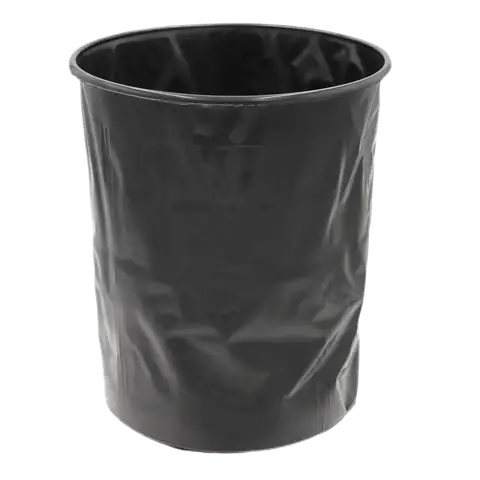
With a black conductive liner ($le 10^5 Omega/ ext{sq}$) cuffed over the top chime of a grounded steel drum, static charges drain to earth in milliseconds. You get all the operational perks of a drum liner—zero solvent drum washing, fast color changeovers, and 100% drum reuse—while passing the strictest ATEX Directive 1999/92/EC and TRGS 727 plant safety audits.

4. Full Engineering Matrix: Pink Anti-Static vs. Black Conductive PE
Use this side-by-side reference table when writing your purchasing specification or preparing for an EHS audit (swipe horizontally on mobile phones):
| Engineering Parameter | Pink Anti-Static PE (Pink Poly) | Black Carbon-Conductive PE (Lucheng Heavy-Duty) |
|---|---|---|
| Conduction Mechanism | Migrating internal surfactants (amines / GMS) adsorbing ambient air moisture (ionic conduction) | High-structure nano-carbon black percolation network (physical electron tunneling) |
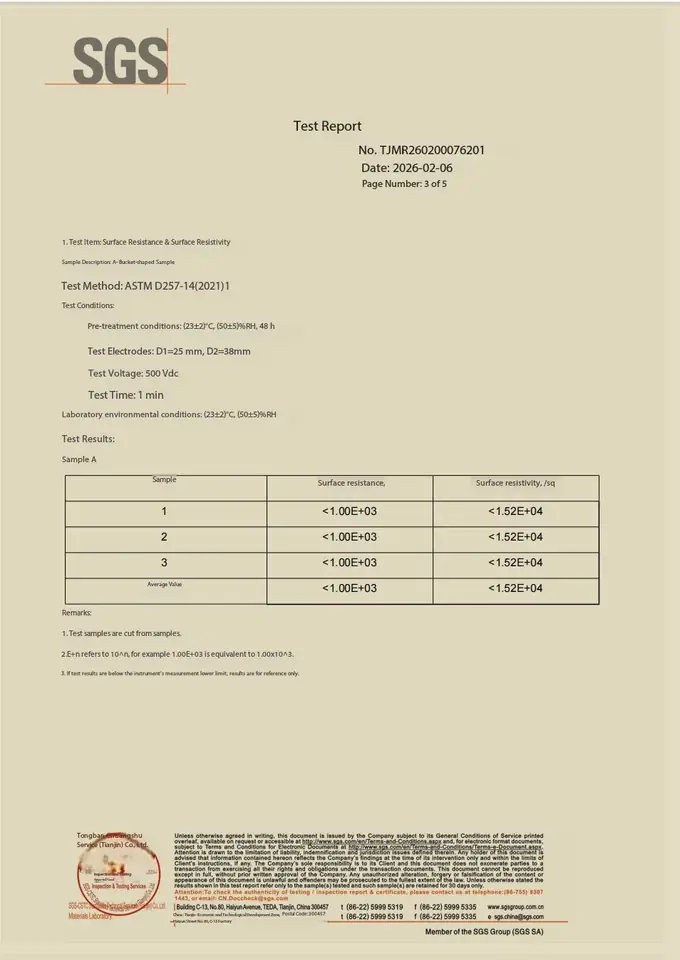
| Surface Resistivity (ASTM D257) | $1.0 imes 10^9 sim 1.0 imes 10^{11} Omega/ ext{sq}$ (Static Dissipative) | $1.0 imes 10^3 sim 1.0 imes 10^5 Omega/ ext{sq}$ (Conductive, SGS Verified) |
| Static Decay Rate (5,000V to 50V) | $< 2.0 ext{ seconds}$ (at $50% ext{ RH}$) | $< 0.05 ext{ seconds}$ (Instantaneous when grounded) |
| Low-Humidity Stability ($<20% ext{ RH}$) | Poor for standard amine pink; degrades into $10^{12}+ Omega/ ext{sq}$ in dry winter air | 100% Permanent; unaffected by $10% ext{ RH}$ dry rooms or multi-year storage |
| Optical Light Transmission | Translucent (allows visual part checks & barcode scanning through the film) | 100% Opaque (blocks UV light for photosensitive resins; requires external barcode labels) |
| Chemical Purity & Outgassing | Standard amine pink can outgas and cause polycarbonate crazing or coating cure inhibition | Zero amine/amide surfactants; zero chemical leaching into solvents or adhesives |
| Primary Product Formats | Poly tubing rolls, flat ESD bags, reclosable zipper bags, pallet dust covers | 10L/20L/30L/200L drum liners, round-bottom inserts, heavy-duty conductive sheet rolls |
| Ideal Industry Scenarios | PCB kitting, wire harnesses, medical device sub-assemblies, general warehouse spare parts | Solvent-borne coatings, automotive paints, inks, adhesives, API powders, ATEX Zone 1/2 plants |
5. Frequently Asked Questions From EHS & Packaging Engineers
Q1: Can Lucheng manufacture Poly Tubing Rolls in black conductive PE if our project requires it?
Yes. While 90% of generic e-commerce tubing rolls are pink because of electronics kitting habits, we custom-extrude continuous Black Conductive PE Tubing Rolls and gusseted sleeves for chemical chutes, explosive powder transfer, and UV-sensitive adhesives. We tune the melt-flow index and co-extrusion skin so your operators can still heat-seal it reliably on standard industrial impulse sealers.
Q2: What if we need a drum liner for flammable solvents, but our operators still want to see the liquid level through the bag?
You have two proven options: First, for ATEX Zone 2 environments where $10^7 sim 10^9 Omega/ ext{sq}$ dissipative performance is sufficient, we extrude permanent non-amine translucent anti-static liners (available in clear, pink, or blue tint) using inherent dissipative polymers (IDP) that won’t dry out in winter. Second, for strict ATEX Zone 1 grounding ($<10^5 Omega/ ext{sq}$), we can supply 3D round-bottom liners or thermoformed rigid inserts (10L, 20L, 30L, 200L) with calibrated conductive grounding strips.
Q3: How do you ground a black conductive liner inside a 200L steel drum?
It is remarkably simple: fold the top cuff of the black conductive liner 5–10 cm over the bare metal rim (chime) of the open-head steel drum, and attach your plant’s standard braided copper grounding clamp directly over the cuffed rim (so the clamp teeth contact both the conductive liner and the grounded steel drum). Because the liner wall has a surface resistivity $le 10^5 Omega/ ext{sq}$, the entire interior liquid contact surface is immediately equipotentially bonded to earth.